Investment CoursesDrone “Swarm Warfare” Ignites Capital Markets as Swarmer Surges 520% on IPO Debut
On March 17, the U.S. stock market witnessed a remarkable IPO as drone software company Swarmer (SWMR.US) captured widespread attention. Priced at just $5 per share, the stock surged intraday to around $40, representing a near 700% increase. Despite a partial pullback, it closed at $31, marking a staggering 520% gain in a single day and a market capitalization of approximately $350 million. This makes it one of the most impressive IPOs in the past five years, second only to the record previously set by Newsmax. The secondary market has shown highly emotional enthusiasm for “next-generation warfare technology,” with capital seemingly shifting from traditional tech narratives to the intersection of AI and defense.
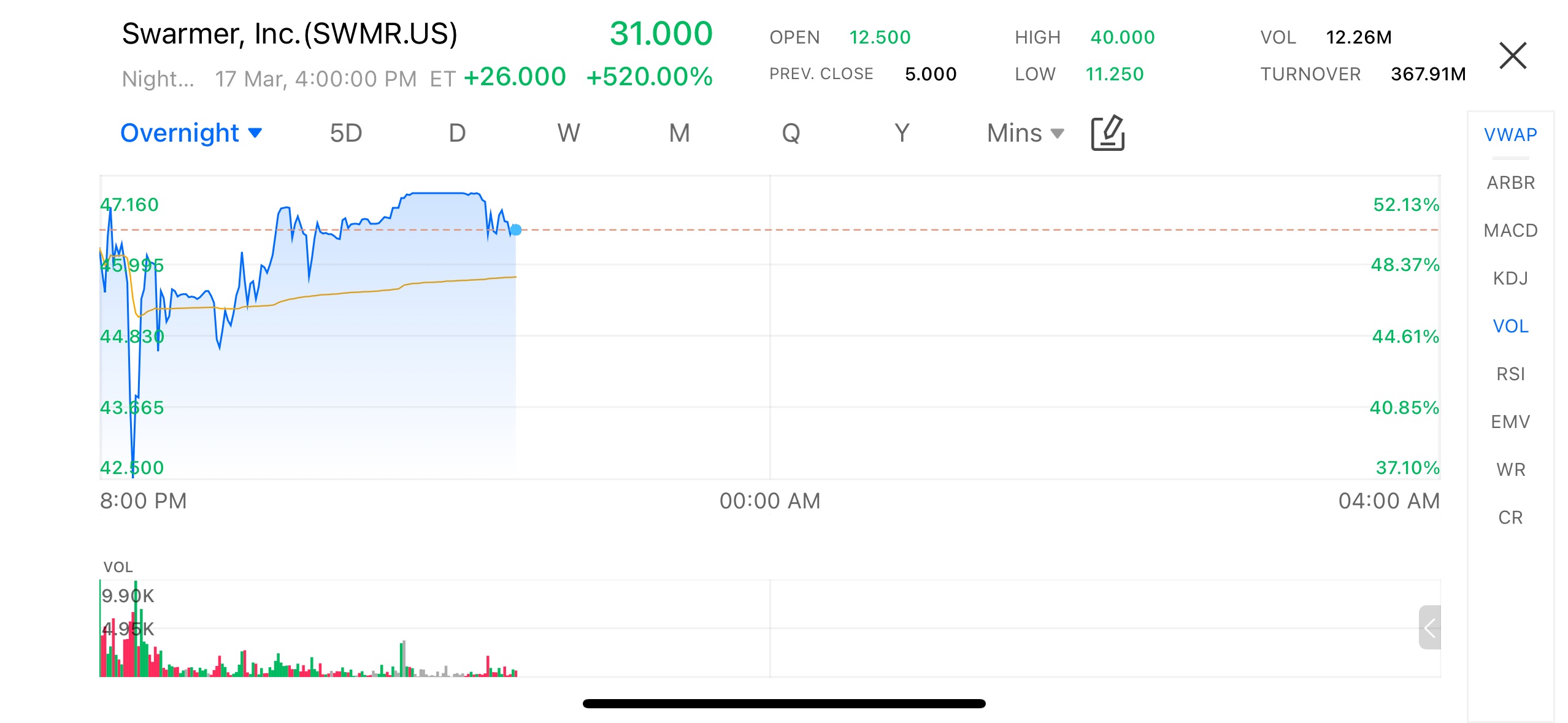
(Image source: uSMART HK app)
From Single Units to Swarms: The Logic of Drone Warfare is Being Rewritten
Swarmer’s core competitive advantage lies not in hardware, but in its “swarm-based coordinated combat” system for drones. Through autonomous control software, multiple drones can execute coordinated decision-making and distributed actions, enabling a single operator to command dozens or even hundreds of drones to complete complex missions.
This technology fundamentally changes modern combat logic, shifting from “platform-centric” to “system-centric” warfare. Compared with conventional individual drones, swarm systems are more resilient: even if some units are destroyed, the overall mission can continue. With drones being increasingly deployed in conflicts—particularly validated in real combat scenarios in Ukraine—this technology is no longer conceptual and is on the cusp of large-scale deployment.
Mismatch Between Performance and Valuation: Why Early-Stage Companies Can Command High Premiums
From a fundamental perspective, Swarmer remains a typical early-stage company. Its revenue in 2025 was only around $300,000, slightly down year-over-year, and it recorded losses exceeding $8 million.
However, the market is more focused on “order prospects” and “application scenarios.” The company currently has over $16 million in backlog orders and approximately $17 million in potential contracts, indicating revenue release opportunities over the next 12–24 months.
Crucially, its technology has been validated in real combat and has established operational records—a rarity among early-stage defense tech companies. Therefore, the market’s valuation is more heavily based on the “future form of warfare” rather than traditional financial metrics.
AI-Driven Defense Sector Heating Up: New Players Challenge Established Giants
The sector in which Swarmer operates is attracting increasing capital and technological attention. Existing players include emerging defense tech companies such as Anduril Industries and Shield AI, as well as traditional defense giants like Lockheed Martin and Northrop Grumman.
Unlike conventional defense companies that rely on large-scale platforms, next-generation firms emphasize software-defined, AI-driven systems, leveraging algorithms and system capabilities to integrate into warfare networks. This model offers greater scalability and aligns with military demand for low-cost, high-efficiency operations.
From Hot Topic to Trend: Will Drone Technology Become a Long-Term Investment Theme?
Swarmer’s highly successful IPO is not an isolated event; it is the result of global security shifts combined with technological evolution. From Eastern Europe to the Middle East, drones have evolved from auxiliary tools to core battlefield assets.
For capital markets, this signals a potential long-term investment logic: “technological revolution driven by upgraded warfare forms,” leading to a revaluation across the industry chain. Drone control systems, AI decision algorithms, communication networks, and counter-drone technologies may all emerge as key investment areas. However, caution is warranted: early-stage companies like Swarmer still face unclear commercialization paths, high customer concentration, and strong policy dependence. Short-term stock surges largely reflect expectations rather than guaranteed outcomes.
Conclusion: Capital Revaluation Triggered by Warfare Technology
Swarmer’s IPO is not merely a single-stock event, but a signal that as warfare enters the era of intelligence and swarm operations, capital markets are also redefining the boundaries of defense technology.
In this high-volatility, high-imagination sector, the companies most likely to endure market cycles will be those that can both deliver practical applications and continuously iterate on technology.
How to Buy Swarmer via on uSMART
After logging into the uSMART HK app, click the “Search” button in the top-right corner of the page, enter the ticker code (SWMR.US), and navigate to the details page to view transaction details and historical trends. Click the “Trade” button in the bottom-right corner, select the trade type, and submit your order after filling in the transaction conditions.
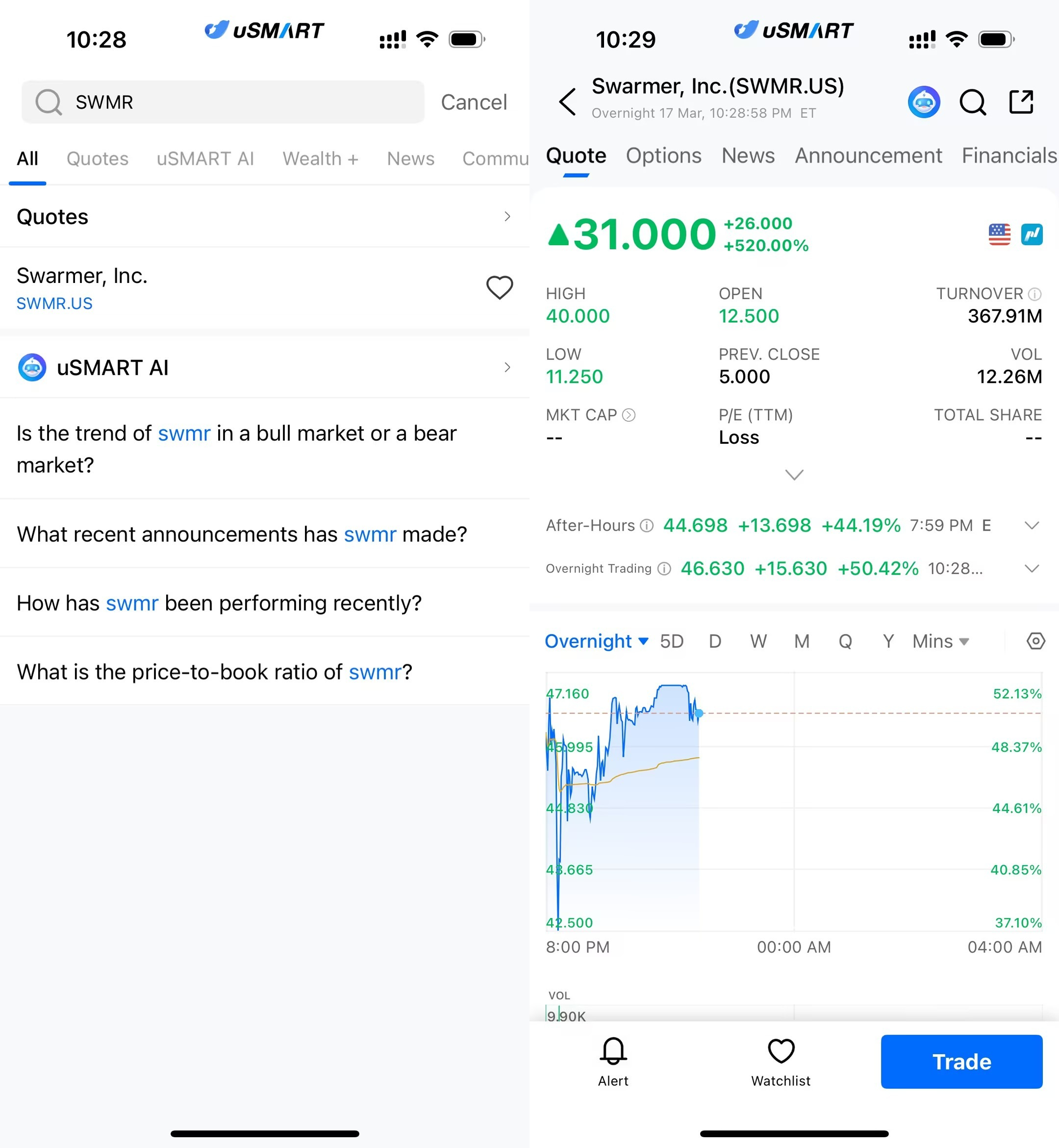
(Image Source: uSMART HK app)


More Content