Investment CoursesTencent Accelerates AI Commercialization as Shares Rise Over 3% Amid Growing Focus on Monetization of Large Models
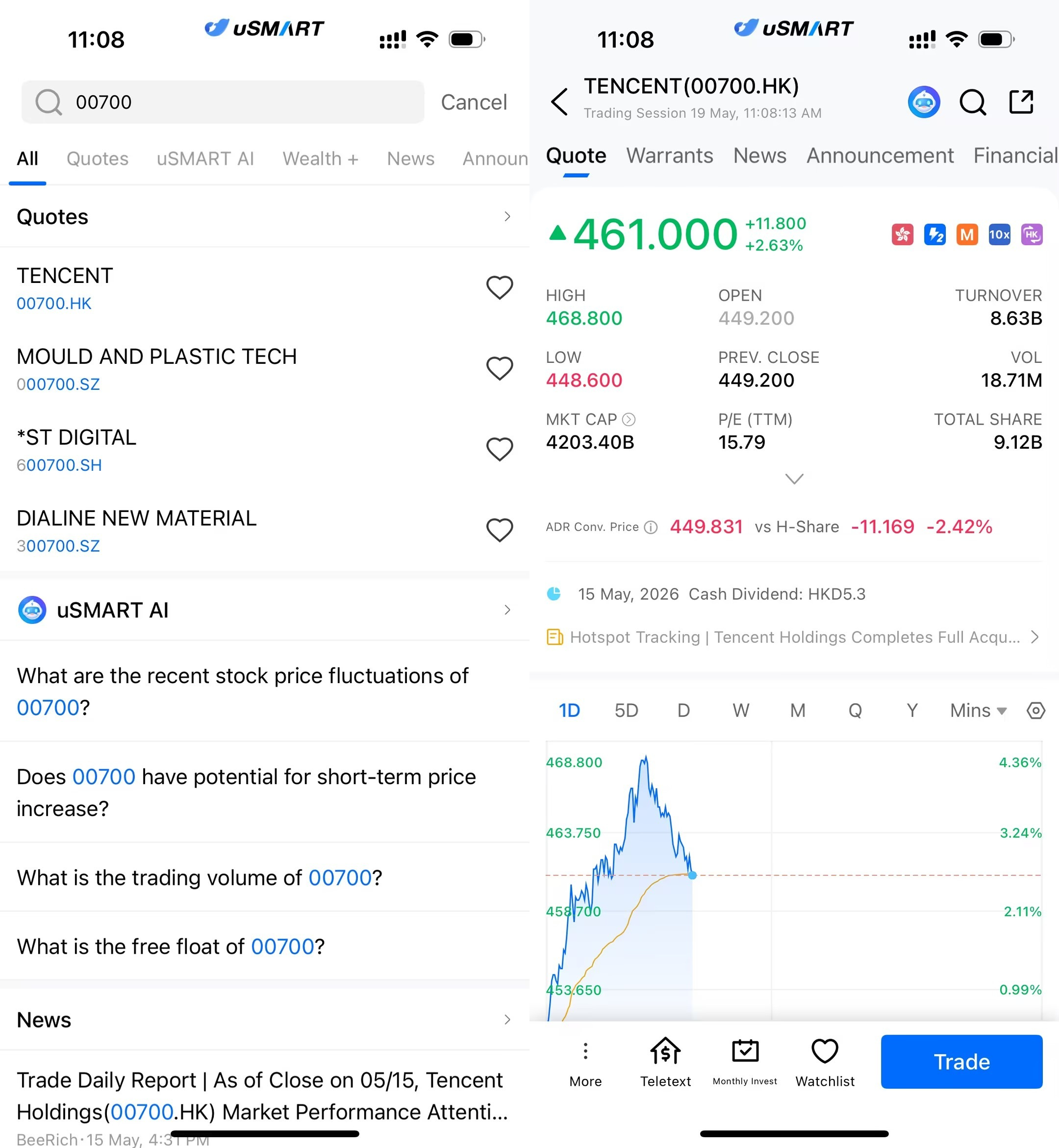
On May 19, Hong Kong-listed major technology stocks traded mixed, while shares of Tencent Holdings showed relative strength. As of 3:11 p.m. HKT, Tencent Holdings (00700.HK) was trading at HK$462.8, up 3.03%, after reaching an intraday high of HK$468.8. Turnover amounted to approximately HK$12.654 billion, with trading volume reaching 27.4463 million shares. Market attention was primarily focused on the latest commercialization progress of Tencent Cloud’s AI models.

(Image Source: uSMART HK app)
Tencent Cloud Announces End of Free Public Beta for Two AI Models
According to Tencent Cloud, the Hy3 preview and DeepSeek-V4-Pro models available on its AI agent development platform will officially end their limited-time free public beta at 10:00 a.m. Beijing time on May 27, 2026, and transition into commercial operation. Going forward, both models will adopt usage-based pricing based on token consumption.
Tencent Cloud disclosed that, after commercialization, the Hy3 preview model will charge RMB0.002 per thousand input tokens and RMB0.008 per thousand output tokens. Meanwhile, DeepSeek-V4-Pro will charge RMB0.012 per thousand input tokens and RMB0.024 per thousand output tokens.
The transition from free testing to formal monetization signals Tencent’s continued efforts to move its AI capabilities from technical validation toward scalable revenue generation, while also reflecting accelerating enterprise adoption of AI applications.
Hunyuan Ecosystem Enters an “Application-Driven” Phase
Tencent has recently accelerated developments in the large-model sector. Previously released Hy3 preview is regarded as one of the key upgraded versions following the restructuring of Tencent’s Hunyuan model ecosystem. Public information shows that the model adopts a “fast-slow thinking integration” architecture, with enhanced Agent-based task execution capabilities designed to improve reasoning efficiency and tool utilization in complex scenarios.
At the same time, the DeepSeek-V4 series has attracted broad attention across China’s AI industry. Publicly available information indicates that DeepSeek-V4 supports million-level context windows and has upgraded capabilities in Agent reasoning, world knowledge, and long-context processing.
Industry observers generally believe that competition among Chinese large-model developers is gradually shifting away from parameter-scale competition toward ecosystem and application competition. Model invocation volume, enterprise adoption scale, and commercialization capability are increasingly becoming the key performance indicators.
Rising AI Usage Strengthens Commercialization Expectations
Industry data also suggests that demand for AI model usage in China continues to expand rapidly. Public data shows that, in the global AI large-model invocation rankings released in early May, Tencent’s Hy3 preview (free) ranked first globally, with weekly token usage reaching approximately 2.68 trillion tokens. DeepSeek-V4-Pro also entered the global top ten for the first time.
As token consumption continues to rise, investors are increasingly focusing on the revenue conversion capabilities of cloud platforms. Compared with relying solely on model-performance competition, large internet platforms with established ecosystems spanning social networking, content, payments, and enterprise services may be better positioned to build an integrated “model + application + cloud service” ecosystem.
In a previous research note, Citigroup stated that Tencent management expressed satisfaction with the performance improvements of the Hunyuan 3.0 model during its first-quarter 2026 earnings conference call. Management also emphasized that high token usage and deep integration with Tencent’s core internal products remain central pillars of its AI strategy. The company further noted that integration between Hunyuan models and the WeChat ecosystem would proceed gradually and eventually expand toward larger-scale models.
Cloud Business May Become Tencent’s Core AI Monetization Gateway
Market focus on Tencent’s AI strategy has gradually shifted from model releases themselves toward commercialization pace and profitability potential. Analysts believe Tencent possesses a broad range of native application scenarios — including WeChat, Tencent Meeting, Tencent Docs, advertising, and gaming — which provide natural user traffic and data entry points for AI deployment. Tencent Cloud is therefore expected to become a major commercial platform for exporting Tencent’s AI capabilities.
From an industry competition perspective, as more Chinese AI companies enter paid commercialization stages, pricing structures, token efficiency, and enterprise integration capabilities are likely to become increasingly important determinants of market share.
For Tencent, the coordinated development of cloud services and AI models may help further increase the contribution of enterprise-service revenue while strengthening its competitiveness within China’s AI infrastructure market.
How to Buy Tencent on uSMART
After logging into the uSMART HK app, click the “Search” button in the top-right corner of the page, enter the ticker code (00700.HK) , and navigate to the details page to view transaction details and historical trends. Click the “Trade” button in the bottom-right corner, select the trade type, and submit your order after filling in the transaction conditions.
(Image Source: uSMART HK app)


More Content