On March 11, NIO Inc. (09866.HK) shares rallied sharply, reaching an intraday high of HK$45.66, and were trading at HK$43.90 at the time of reporting, up 15.10%. Daily turnover reached 13.68 million shares, with a total transaction value of HK$601 million, pushing the company’s market capitalization past HK$109.8 billion. Investors responded enthusiastically to NIO’s Q4 2025 earnings report, which revealed the company’s first-ever quarterly profit, officially ending its continuous losses since listing.
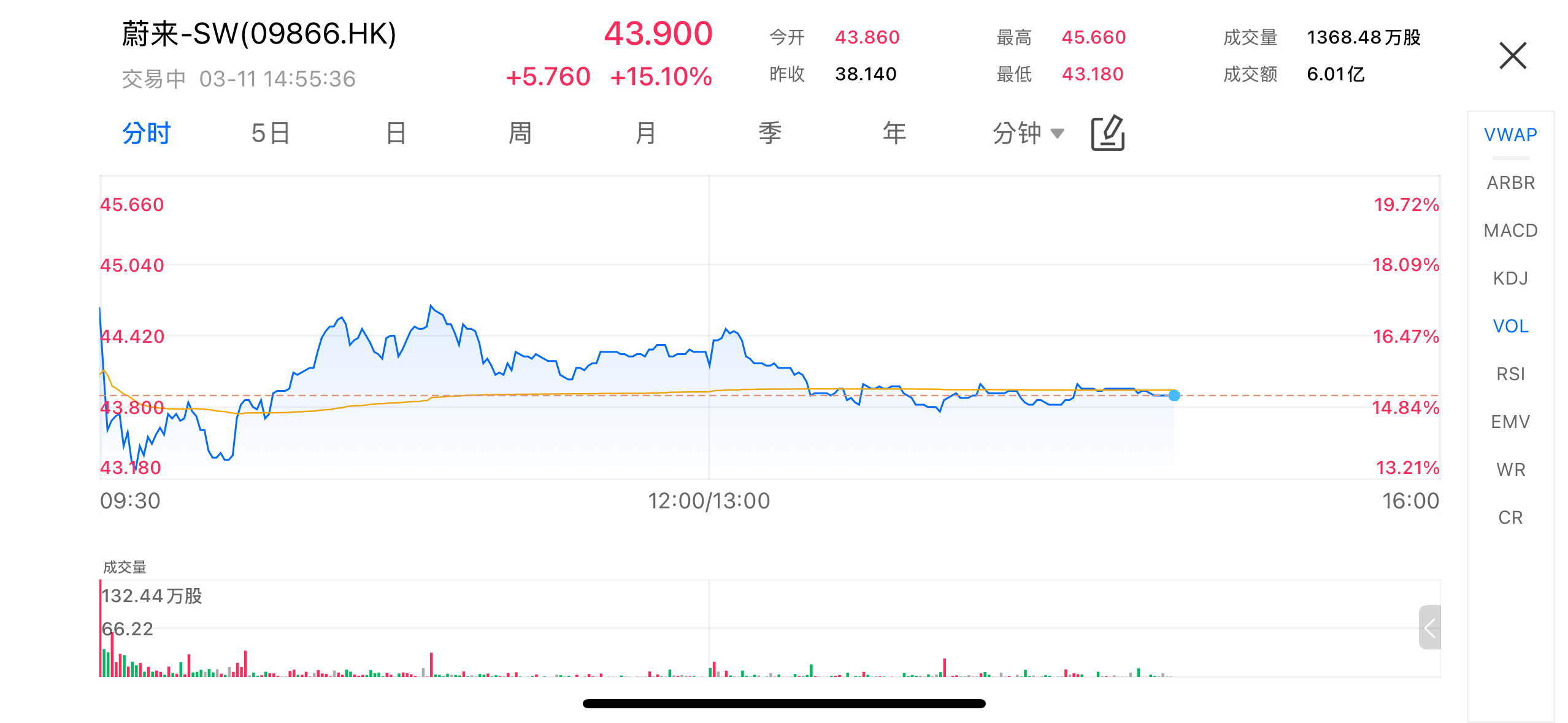
(Image source: uSMART HK app)
Q4 Net Profit of RMB 282.7 Million: Li Bin Delivers on Promise
NIO reported a net profit of RMB 282.7 million for Q4 2025, with net income attributable to ordinary shareholders of RMB 122.4 million—both marking the company’s first profitable quarter. Quarterly revenue reached RMB 34.65 billion, up 75.9% year-on-year and 59% quarter-on-quarter, setting a record high.Chairman Li Bin had previously pledged in March 2025 that the company would achieve profitability in Q4 of the same year. In media interviews, he noted that failing to meet this target would pose a severe test to NIO’s long-term development and business model. The quarterly profit demonstrates that Li’s commitment has been fulfilled, sending a positive signal about NIO’s improving fundamentals to the market.
Record Deliveries: High-End Models Drive Profitability
The report shows that NIO delivered 124,807 new vehicles in Q4 2025, up 71.7% year-on-year and 43.3% quarter-on-quarter. Among them, 67,433 units were the high-end ES8 smart electric SUV, 38,290 units were from the family-oriented Ledo brand, and 19,084 units were the small EV Firefly model.The new ES8, with a gross margin close to 25%, was the core contributor to quarterly profits, accounting for 31.8% of total deliveries. Overall vehicle gross margin for the quarter reached 18.1%, up 5 percentage points year-on-year and 3.4 percentage points quarter-on-quarter, the highest in three years. Margin improvement was mainly driven by product mix optimization and cost efficiencies from the self-developed automotive-grade 5nm smart driving chip, “Shenji NX9031.” According to Li Bin, deploying this chip can reduce per-vehicle costs by around RMB 10,000, significantly boosting unit profitability.
Full-Year Performance Improves, Net Loss Narrows by 33%
For the full year, NIO reported total revenue of RMB 87.488 billion in 2025, up 33.1% year-on-year. Net loss narrowed to RMB 14.943 billion, a decline of 33.3% year-on-year, while net loss attributable to ordinary shareholders was RMB 15.571 billion, down 31.28%. Total gross profit reached RMB 11.92 billion, up 83.5%, and overall vehicle gross margin improved 2.3 percentage points to 14.6%. Total deliveries for the year reached 326,028 vehicles, up 46.9%.NIO has issued guidance for Q1 2026, projecting deliveries of 80,000–83,000 units, representing a year-on-year increase of approximately 90%–97%, and revenue guidance of RMB 24.48–25.18 billion, up 103%–109%, signaling strong confidence in its profitability outlook.
Increased Investment in Smart Driving Chips to Strengthen Core Competitiveness
NIO continues to invest in its smart driving chip business. In February 2026, its subsidiary Anhui Shenji Technology Co., Ltd. completed its first round of equity financing, raising over RMB 2.2 billion, with a post-money valuation approaching RMB 10 billion. The financing involved multiple leading investors, including Hefei State-owned Investment, IDG Capital, and SMIC Capital.Li Bin revealed during the earnings call that Shenji’s second-generation advanced smart chip, designed for broader customers, has successfully taped out and is in mass production. Since its launch in 2024, the self-developed “Shenji NX9031” chip has shipped over 150,000 units, deployed across all NIO models, effectively supporting improved vehicle gross margins and cost optimization.
Significant Improvements in Cost Control and R&D Efficiency
The report shows that R&D expenses in Q4 2025 were RMB 2.026 billion, down 44.3% year-on-year, and selling, general and administrative expenses were RMB 3.54 billion, down 27.5%. CFO Qu Yu stated that NIO plans to maintain quarterly R&D spending of RMB 2–2.5 billion in 2026 while improving R&D efficiency through the CBU operational model to avoid ineffective investment.Over the long term, NIO’s strategic investments in in-house chips, battery-swapping systems, and charging infrastructure build core technological capabilities and commercial moats. Over the past several years, the company has invested more than RMB 18 billion in battery swapping and full-stack self-development, laying the foundation for sustainable profitability.
How to Buy NIO via on uSMART
After logging into the uSMART HK app, click the “Search” button in the top-right corner of the page, enter the ticker code (09866.HK), and navigate to the details page to view transaction details and historical trends. Click the “Trade” button in the bottom-right corner, select the trade type, and submit your order after filling in the transaction conditions.
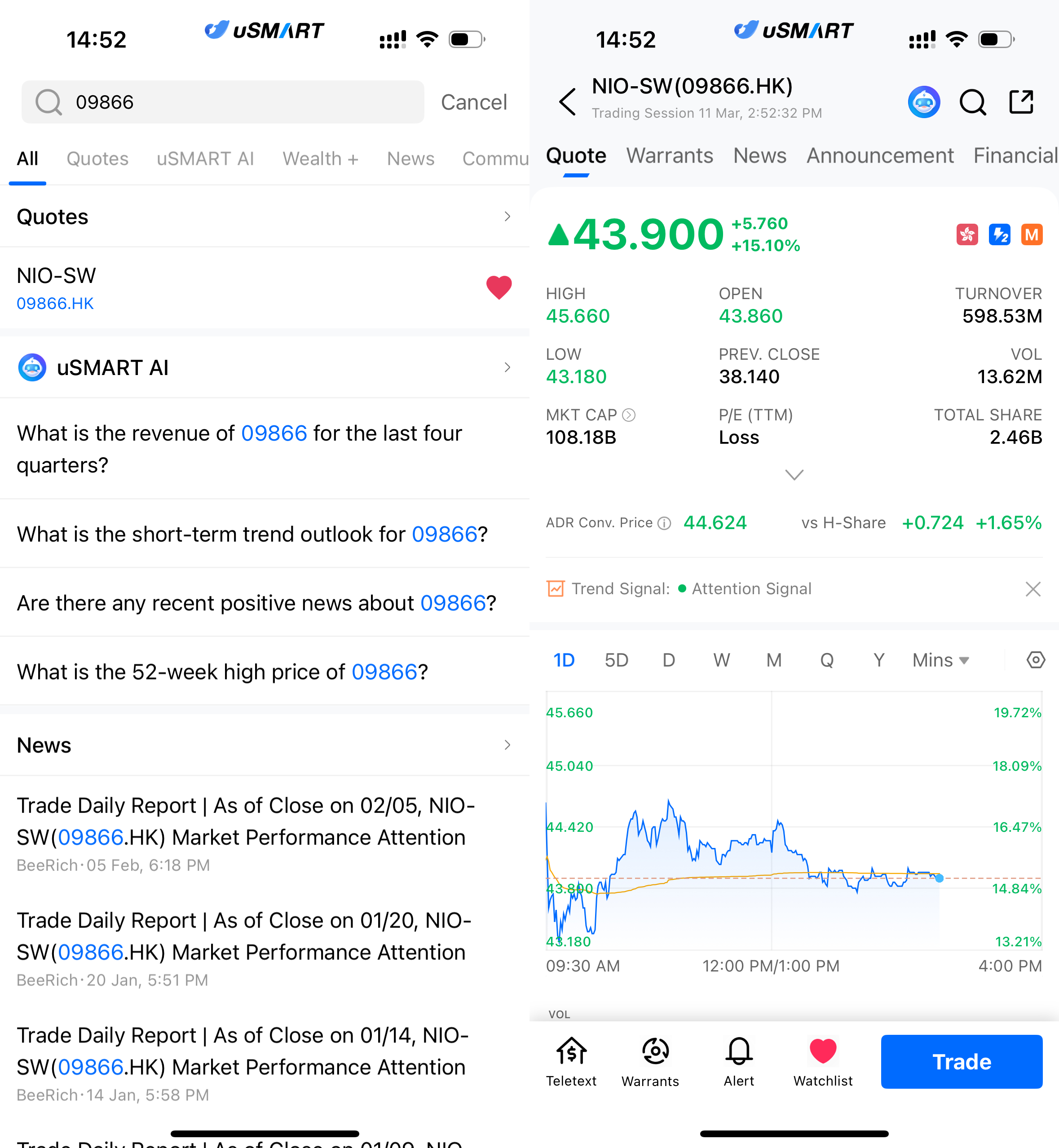
(Image Source: uSMART HK app)


More Content