Market NewsTencent Bets on WeChat AI Agents: Battle for the Next-Generation “Super Portal” Underway
As of the close on March 12, Tencent Holdings (00700.HK) shares were priced at HK$546.5, down 1.0%, with a turnover of approximately HK$10.765 billion. Looking at recent trends, Tencent’s share price has steadily risen from around HK$500 over the past five trading days, peaking at HK$578 during this period, representing a gain of nearly 15%. Market attention is focused on Tencent’s latest AI initiatives. The company is developing an AI Agent for WeChat, which, if progress goes smoothly, is expected to begin testing by mid-year and gradually roll out to users in the third quarter.
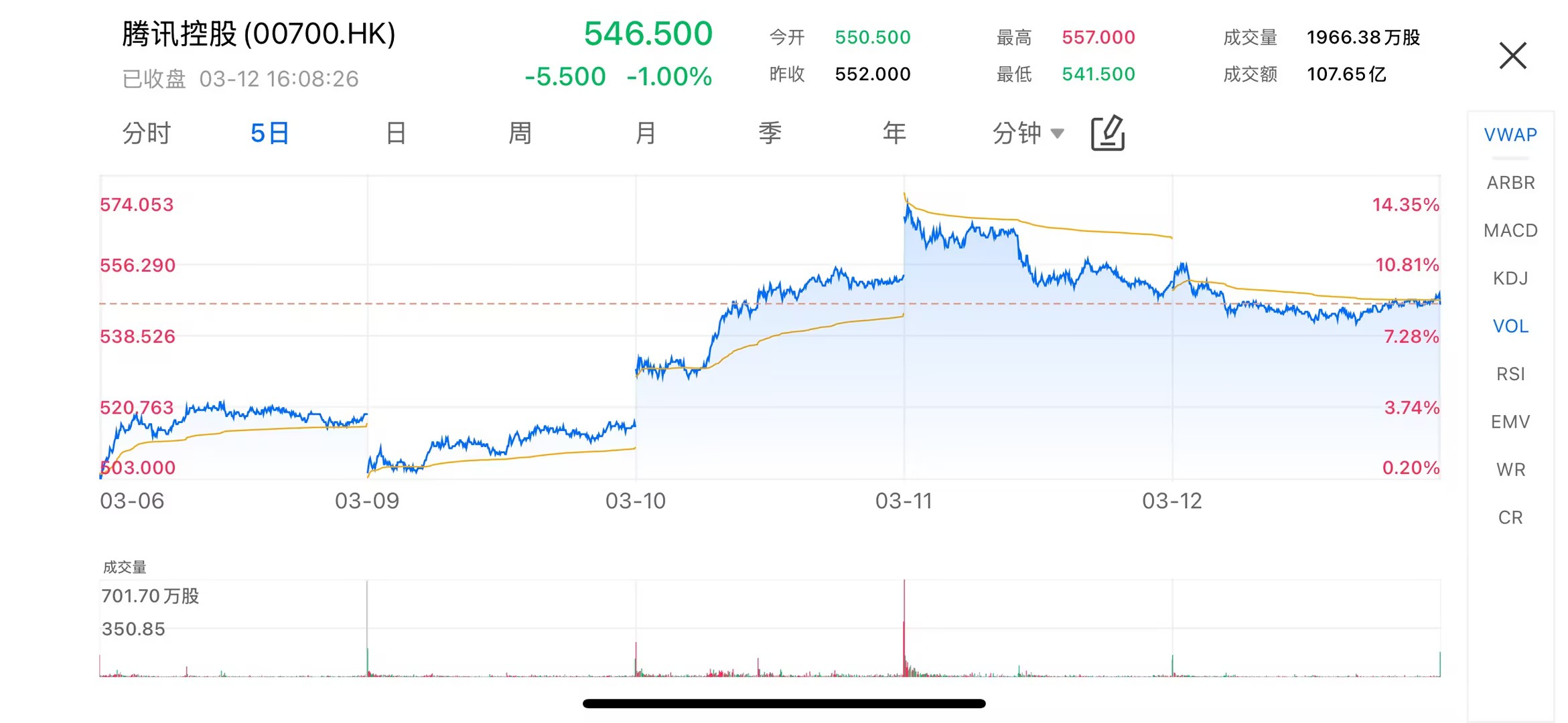
(Image source: uSMART HK app)
WeChat + AI Agent: From Super App to “Intelligent Portal”
Unlike many tech companies that launch standalone AI applications, Tencent prefers to integrate AI capabilities directly into WeChat. The AI agent may appear in the chat interface in conversational form, allowing users to invoke various services via natural language commands.
For example, a user could type “Book me a flight to Shanghai tomorrow,” and the AI would automatically search, compare prices, and place the order. In scenarios such as food delivery, ride-hailing, or hotel booking, it could also directly leverage mini-programs to complete tasks. This means the AI does not merely provide answers but can perform actions on the user’s behalf.
Leveraging WeChat’s massive user base and mature mini-program ecosystem, the integration of AI agents into WeChat’s service network could rapidly expand application scenarios and usage frequency.
From Standalone Apps to Ecosystem Integration: Tencent’s Strategic Shift
Over the past year, Tencent has been relatively cautious in advancing AI applications. Its previously launched AI app, “Yuanbao,” drew some attention but lagged behind leading industry products in overall user scale.
In this context, Tencent is adjusting its approach—shifting from relying on standalone apps to embedding AI capabilities in high-frequency products. Recently, the company has launched multiple AI agent products covering personal device control, enterprise collaboration, and office assistant scenarios, directly integrated with WeChat, WeCom, and QQ.
Industry observers suggest this model lowers user adoption barriers, enabling AI to integrate more quickly into daily application scenarios.
Competition for AI Portals Intensifies: Giants Vie for Next-Generation Traffic Hub
From an industry perspective, AI agents have become a new battleground for tech giants. Compared with traditional chatbots, AI agents can perform multi-step tasks and are seen as the next-generation human-computer interaction form.
Currently, Chinese internet companies are accelerating their AI deployments. Alibaba Group is integrating AI capabilities into its e-commerce and payment ecosystems, while ByteDance continues to enhance its AI assistant functions.
Tencent’s advantage lies in WeChat as a “super portal.” Once the AI agent is deeply integrated into chat scenarios, its user reach could far exceed that of standalone AI applications. Analysts generally believe that AI competition is shifting from “model capability” to “control of user entry points”; whoever secures the high-frequency user portal is likely to gain a strategic advantage in the next phase of competition.
How to Buy Tencent via on uSMART
After logging into the uSMART HK app, click the “Search” button in the top-right corner of the page, enter the ticker code (00700.HK), and navigate to the details page to view transaction details and historical trends. Click the “Trade” button in the bottom-right corner, select the trade type, and submit your order after filling in the transaction conditions.
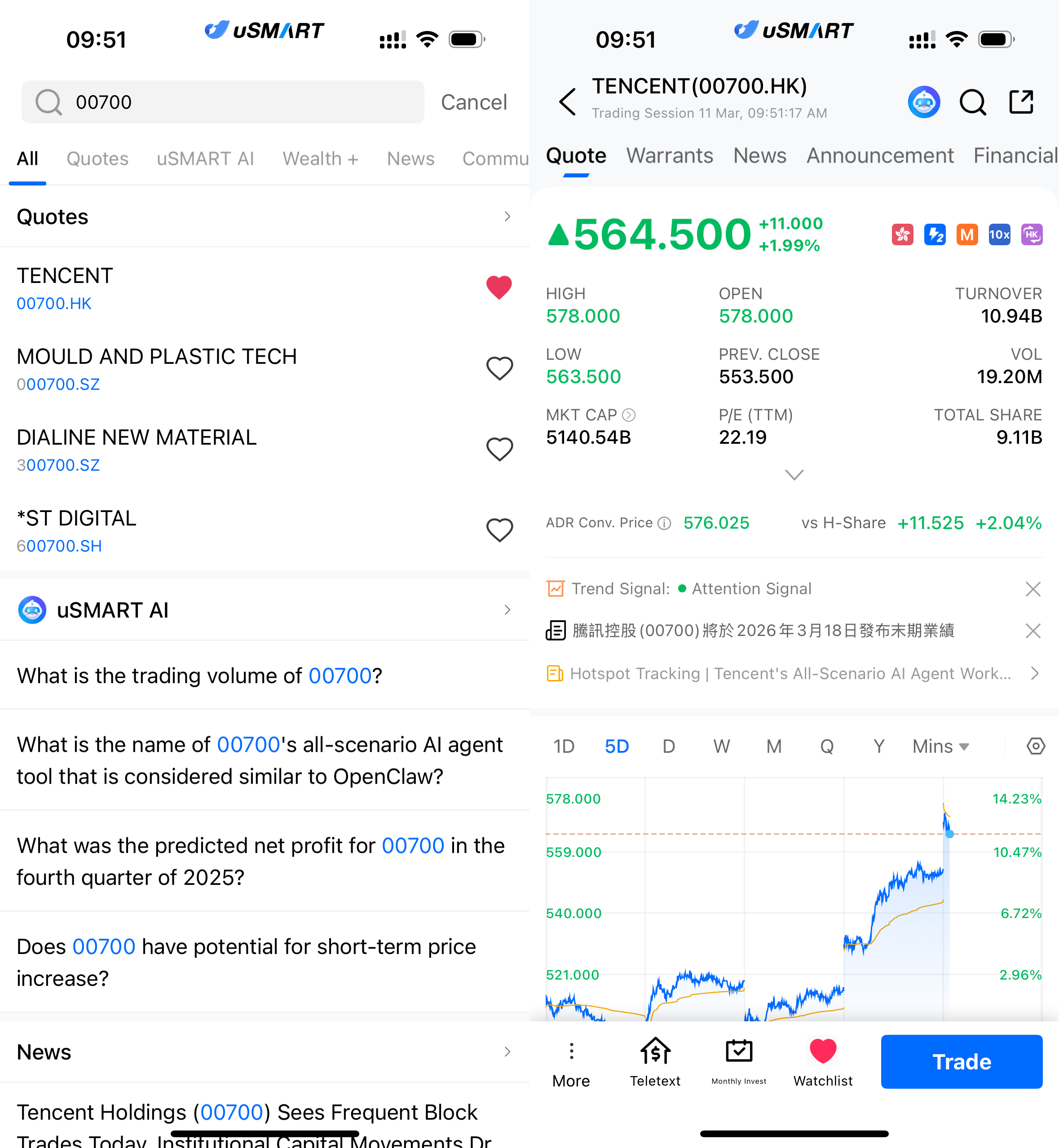
(Image Source: uSMART HK app)


More Content