Investment CoursesArm Shares Surge 13.63% as AI Data Center Demand Booms, Company Eyes CPU Market Leadership by 2030
As of 4:00 p.m. ET on May 6, Arm Holdings (ARM.US) closed at $237.30, up $28.46, or 13.63%, with the stock hitting an intraday high of $239.50 — a record high since its listing. Trading turnover reached approximately $6.16 billion. Investor attention was largely driven by the company’s latest earnings results and its increasingly bullish outlook for AI data center demand.
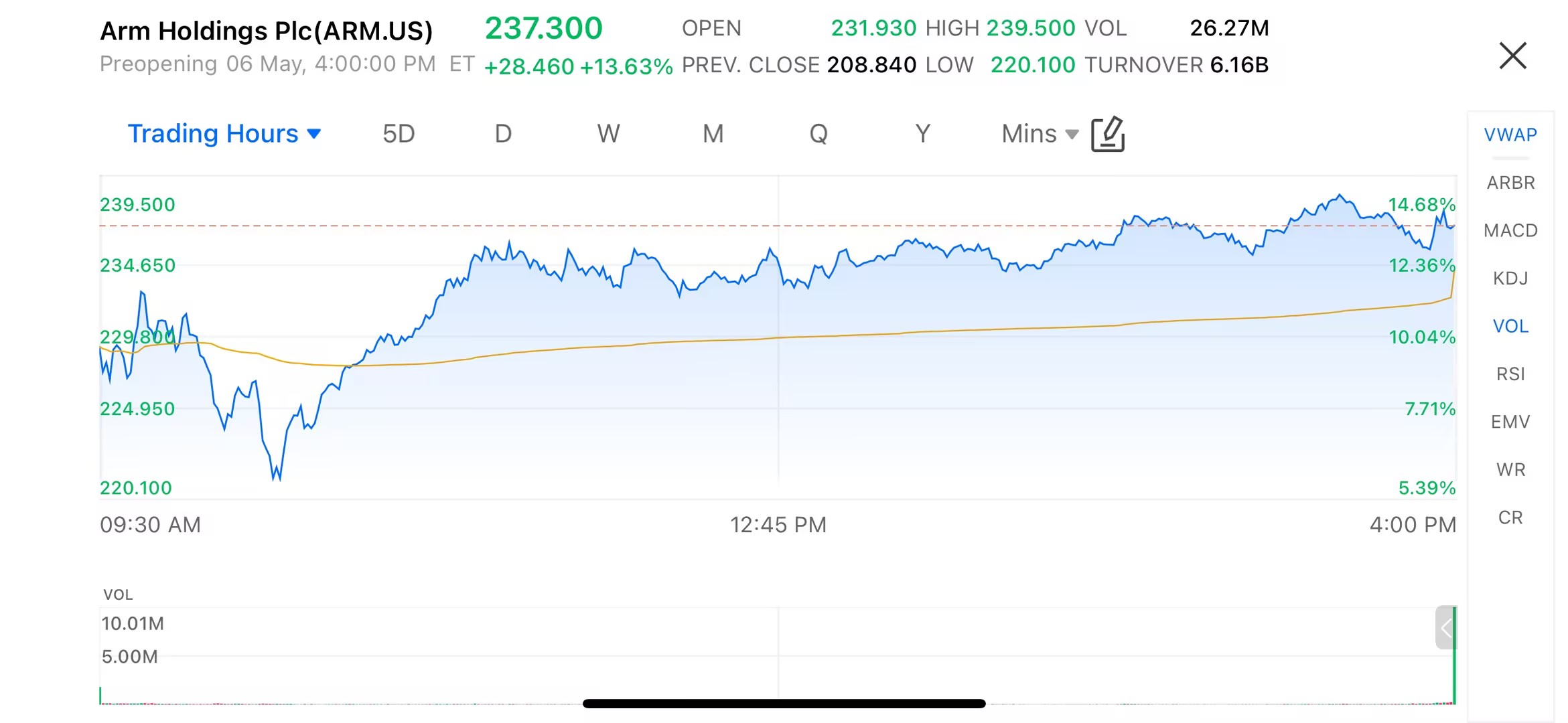
(Image Source: uSMART HK app)
Record Financial Results as Data Center Business Accelerates
Arm reported fourth-quarter revenue of $1.49 billion for fiscal year 2026, up 20% year-over-year and marking a new quarterly record for the company. Full-year revenue reached a record $4.92 billion, representing the third consecutive year of revenue growth exceeding 20%.
License revenue rose 29% year-over-year to $819 million, while royalty revenue increased 11% to $671 million. Notably, data center royalty revenue more than doubled from a year earlier, becoming the company’s most important growth driver during the quarter. Management said the data center segment is expected to continue expanding rapidly and could soon become Arm’s largest business division.
Meanwhile, Arm’s newly launched Arm AGI CPU, introduced in March this year, has quickly attracted strong market interest. Management disclosed that customer demand for the product surged from roughly $1 billion to more than $2 billion within just six weeks of launch, highlighting rapidly rising demand for high-performance CPUs in AI infrastructure.
However, due to ongoing constraints in wafers, packaging, and testing capacity, the company maintained its existing $1 billion revenue target for the product.
Rise of AI Agents Is Reshaping CPU Demand Dynamics
Beyond the headline financial results, investors are increasingly focused on Arm’s view of how AI is changing computing infrastructure.
During the earnings call, Arm CEO Rene Haas repeatedly emphasized that AI agents are expected to become a major next-stage trend within the AI industry. According to Haas, AI systems are evolving beyond simple query-response models toward autonomous agents capable of executing tasks, coordinating workflows, and collaborating across systems.
In this transition, CPUs are regaining strategic importance.
Arm believes AI agents require CPUs to handle task orchestration, data movement, memory management, security functions, and coordination around GPU accelerators. As a result, future AI data centers will require not only GPUs, but also a significant increase in high-core-count CPUs as foundational infrastructure.
The company estimates that the global data center CPU market could exceed $100 billion by 2030, while the proliferation of AI agents could drive CPU capacity demand to more than four times current levels.
High-Core-Count CPUs Become Arm’s Core Strategic Bet
Unlike the traditional server era, where the focus was primarily on chip volumes, Arm is increasingly emphasizing “core count” as a critical metric.
Management believes AI agents are better suited to running independently across large numbers of CPU cores, making core scalability a key competitive advantage for next-generation computing systems.
Arm’s latest AGI CPU currently features 136 cores, while future products could scale to 256 or even 512 cores.
The company also argued that leading-edge GPU designs are approaching physical size limitations, whereas CPUs still have substantial room to expand core counts — one of the key reasons Arm remains highly optimistic about long-term CPU demand growth.
Today, major cloud providers including NVIDIA、Amazon Web Services、 Google Cloud and Microsoft Azure have all adopted Arm-based CPUs in their AI infrastructure deployments.
Google’s latest TPU platform has already replaced traditional x86 host processors with Arm-based Axion CPUs, while NVIDIA’s next-generation Vera platform is also built on Arm architecture.
Haas stated during the earnings call that by 2030, Arm expects to hold the largest market share among CPU architectures globally.
How to Buy Arm on uSMART
After logging into the uSMART HK app, click the “Search” button in the top-right corner of the page, enter the ticker code (ARM.US), and navigate to the details page to view transaction details and historical trends. Click the “Trade” button in the bottom-right corner, select the trade type, and submit your order after filling in the transaction conditions.
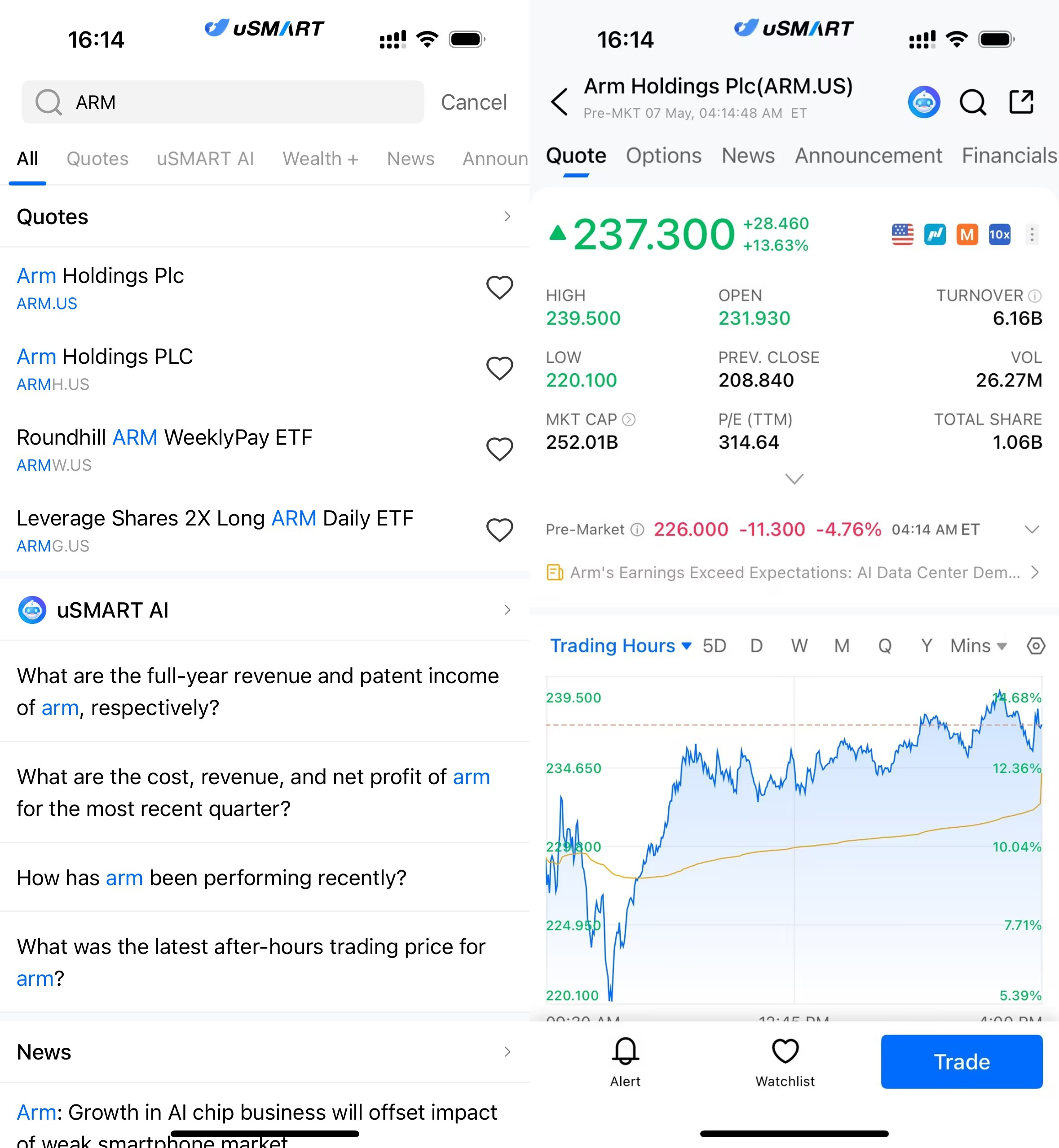
(Image Source: uSMART HK app)


More Content