Currently, Tesla and BYD are the leaders in the new energy sectors of the United States and China, respectively, and they are also the top two in terms of global new energy vehicle sales. In terms of news, BYD's subsidiary,弗 Di Battery (Note: The name "弗 Di" does not have a clear English equivalent and may be a typo or a specific brand name; please provide the correct name if known), reached a supply agreement with Tesla for the Shanghai energy storage factory in March of this year, and will supply energy storage cells to Tesla in the first quarter of next year.
This implies that, amidst sluggish growth in its automotive business, Tesla may start to vigorously promote the development of its energy storage business in the future, and will increase its cell suppliers in advance to ensure the stability and diversification of its cell supply chain; at the same time, BYD is also expected to fully benefit from this cooperation, increase its market share, and further expand its influence in the overseas energy storage field.
Comparison between BYD and Tesla on Different Dimensions
|
Comparison Dimensions |
Tesla |
BYD |
|
Establishment Time |
February 1995 |
July 2003 |
|
Technological Innovation |
Leads in battery technology, autonomous driving, and electric vehicle manufacturing |
Steady advancement in battery technology, with innovations such as self-developed blade batteries |
|
Sales Volume |
Delivered over 1.81 million electric vehicles in 2023 |
Achieved a vehicle sales volume of 18.035 million units in 2023 |
|
Profitability |
GAAP net profit of 7.9 billion U.S. dollars |
Expected net profit attributable to the parent company in 2023 to grow by 74.5%-86.5% year-on-year |
|
Market Share |
Has a significant global influence |
Surpassed Tesla in 2023 to become the global champion in new energy vehicle sales |
|
Business Model |
"Big single product" strategy, relying on core models to achieve mass production |
"Vehicle ocean" tactic, with a rich product line covering a wide range of market demands |
|
Market Strategy |
Adapting to the Chinese market by establishing factories and adjusting pricing strategies |
Strengthening the position in the Chinese market through vertical integration and competitive pricing strategies |
|
After-sales Service |
Has a comprehensive after-sales service system on a global scale |
After-sales service network is relatively well-developed in the Chinese market |
|
Brand Recognition |
A globally leading electric vehicle manufacturer with high brand recognition |
A well-known new energy vehicle brand in China, with after-sales service more in place supported by 4S stores |
|
Battery Technology |
Primarily uses ternary lithium batteries, with some models using lithium phosphate batteries |
Mainly uses lithium iron phosphate batteries, which are safer and have a longer lifespan |
|
Pricing |
Mid to high-end, with relatively higher vehicle prices |
Mid to low-end, with relatively more affordable vehicle prices |
|
Range |
Advanced range and charging technology |
Comparable range, with a slight advantage in fast-charging technology |
|
Brand Image |
Famous for innovative technology and autonomous driving features |
Liked by consumers for reliability and cost-effectiveness |
Tesla Holds an Advantage in Technological Innovation, Brand Recognition, and Global Market Influence, While BYD Excels in Sales, Profitability, Market Share, and Localization of Services. Tesla's Products are Generally Pricer, While BYD Offers More Price Options. Tesla's Battery Technology is Diverse; BYD Focuses Mainly on Lithium Iron Phosphate Battery Technology, Emphasizing Safety and Longevity.
Global Factory Distribution and Production Capacity Comparison
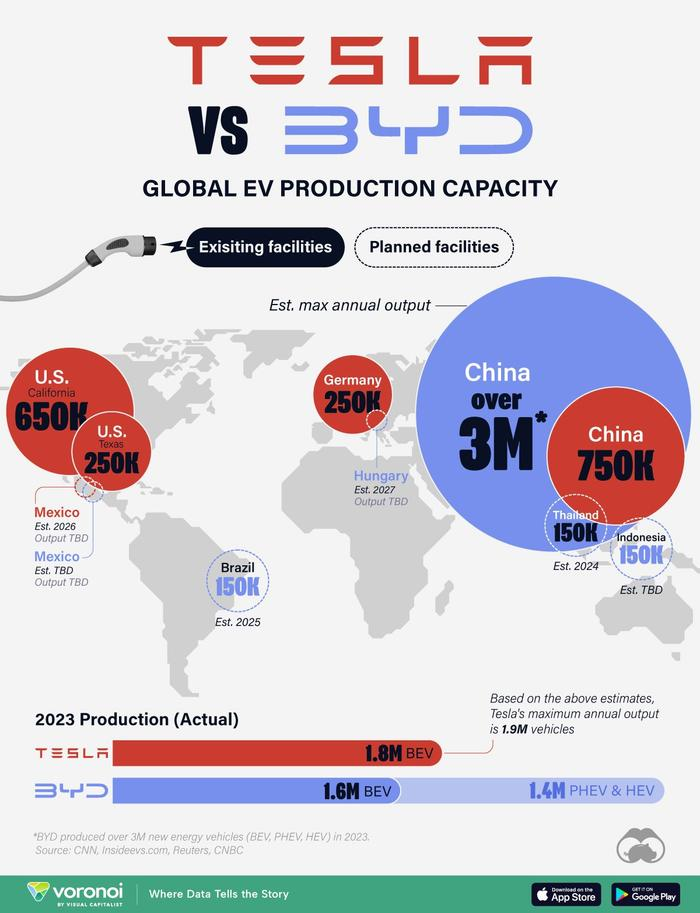
Tesla and BYD are the two largest electric vehicle companies globally. In terms of output, Tesla's production was about 1.8 million vehicles last year, while BYD's total production was about 3 million vehicles (including about 1.6 million pure electric vehicles and about 1.4 million plug-in hybrid vehicles). The following figure lists the existing and planned construction of electric vehicle factories for both car companies, as well as the estimated maximum annual production capacity, according to multiple data sources.
The red solid circles in the figure highlight the locations of Tesla's four operating electric vehicle factories, located in Shanghai, China; Berlin, Germany; California, USA; and Texas, with maximum annual production capacities of 750,000, 250,000, 650,000, and 250,000 vehicles, respectively. The Nevada Gigafactory is not on the list because this factory mainly produces batteries and does not produce complete vehicles. In addition, Tesla's next Gigafactory is located in Mexico, expected to be completed in 2026.
The blue dashed circles in the figure mark the locations of BYD's several overseas factories, including:
1. Thailand Factory: Planned with an annual capacity of 150,000 vehicles, expected to be completed and put into production this year;
2. Brazil Factory: Planned with an annual capacity of 150,000 vehicles, expected to be completed in 2025;
3. Hungary Factory: Estimated capacity to be determined, expected to be completed in 2027;
4. Indonesia Factory: Planned with an annual capacity of 150,000 vehicles, completion time to be determined;
5. Mexico Factory: Still under discussion. In addition, BYD's UZBEK factory officially started production in January of this year, with a planned annual production of 50,000 vehicles for both the first and second phases, and the annual production is expected to reach 300,000 vehicles after the completion of the third phase.
 (Sources: Sina Finance, June 12, 2024)
Sales Distribution Comparison
Tesla's sales distribution: 44% in China, 40% in the United States, and 16% in Europe.
· In the United States, Tesla sold about 181,000 vehicles in the first quarter of 2023 and about 175,000 vehicles in the second quarter. Estimated at 720,000 vehicles for the year!
· In China, Tesla sold about 229,000 vehicles in the first quarter of 2023, which is the best quarter in the region to date. Estimated at 800,000 vehicles for the year!
· In Europe, Tesla sold about 94,696 vehicles in the first quarter of 2023 and a total of about 205,000 vehicles by July. Estimated at 300,000 vehicles for the year!
BYD's sales distribution: 92% domestic and 8% overseas. BYD in 2023, total vehicle sales of 3.02 million, pure electric 1.6 million. Of the 3.02 million vehicles, the export volume exceeded 240,000, BYD's new energy vehicles have reached 57 countries and regions including Japan, Germany, Australia, Brazil, the UAE, etc., with European sales of about 13,000 vehicles! (The above data source: NetEase, January 2024)
Business Comparison
BYD (BYD) is mainly involved in the following business areas:
1. New Energy Vehicles: BYD is one of the world's leading new energy vehicle manufacturers, producing electric vehicles (EVs), plug-in hybrid vehicles (PHEVs), and conventional fuel vehicles.
2. Batteries and Energy Storage: The company also produces various batteries, including lithium-ion batteries for its electric vehicles and batteries for grid energy storage, consumer electronics products, and other applications.
3. Electronic Component Manufacturing: BYD also manufactures components and assembly parts for electronic products such as mobile phones and computers.
4. Rail Transit: The company also develops and manufactures rail transit solutions, such as subways and trams.
5. Solar Products: BYD is also engaged in the manufacturing and sales of solar panels and related products.
6. Other Businesses: Including information technology, automation equipment, and other fields.
Tesla's main business areas now include:
1. Electric Vehicles (EVs): Produces a variety of models of electric vehicles, such as Model S, Model 3, Model X, and Model Y.
2. Energy Storage Solutions: Provides energy storage products for residential, commercial, and industrial use, such as Powerwall, Powerpack, and Megapack.
3. Solar Products: Designs and manufactures solar roof tiles and solar panels.
4. Charging Network: Builds and maintains an extensive network of Supercharger stations.
5. Autonomous Driving Technology: Invests in the research and development of fully autonomous driving technology and provides related software updates for its vehicles.
6. Tesla Bot: Developing humanoid robots for performing repetitive or dangerous tasks.
7. Other Innovative Businesses: Continuously exploring innovation in artificial intelligence, battery technology, and other high-tech fields.


More Content